
7 Sports Most Canadians Have Never Tried
Most Canadians grow up playing a solid range of sports. Hockey, soccer, basketball, swimming, baseball, kayaking, canoeing. But most adults are still doing the same activities they were doing 20 years ago.
Meanwhile, in parks, gyms, and recreation centres across the country, people are playing sports most Canadians have never heard of. Kicking a ball over a net without using their hands. Raiding an opposing team on a single breath. Striking a feathered shuttlecock with their palms.
Canada’s 2021 Census reported more than 450 ethnic or cultural origins and over 450 languages. That cultural diversity shows up in the sports people play. And for anyone looking to challenge their body in a completely new way this summer, it’s an open invitation.
Physical literacy develops when people encounter new movement challenges in new environments. That’s true for children developing foundational skills, but it’s equally true for adults. Trying a sport you’ve never seen before forces your brain and body to solve problems they haven’t faced: unfamiliar coordination patterns, different demands on balance, agility, and reaction time. That’s how a movement vocabulary keeps developing, at any age.
Here are seven sports from around the world that will do exactly that. Some have organized leagues across Canada. Others take more digging. All of them will make you move in ways you haven’t before.
Sepak Takraw (Southeast Asia)
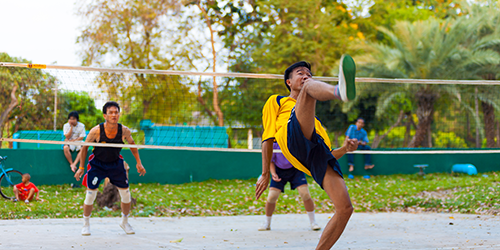
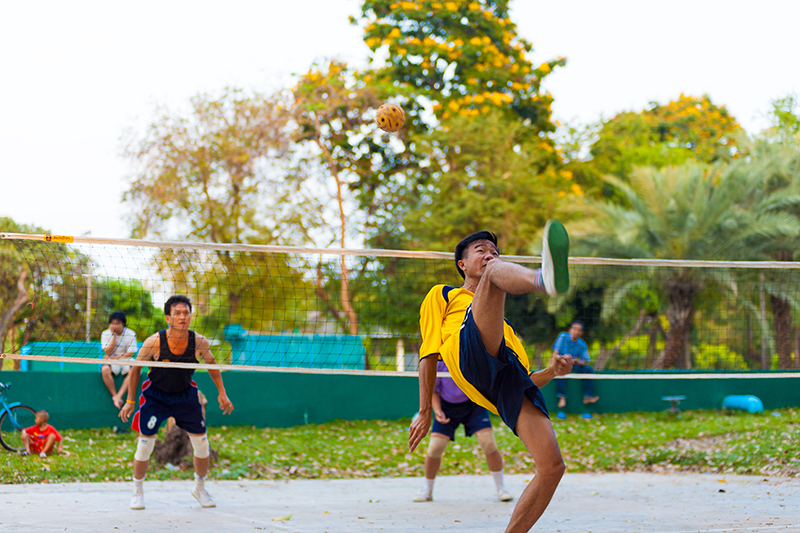
Volleyball, but no hands allowed. Players kick, knee, and bicycle-kick a small plastic ball over a net with acrobatic precision. It demands foot-eye coordination, flexibility, and explosive lower-body power. For anyone used to hand-dominant sports, this is a full reset. The sport took root in Canada through Laotian players in Regina, and the Sepak Takraw Association of Canada was founded there in 1998. Today, affiliated players and clubs can be found across Saskatchewan, Alberta, Ontario, and British Columbia, where a provincial association is currently taking shape. The 2025 Men’s Canadian Open was held in Maple Ridge, B.C. — the first time B.C. hosted the national championship.
Kabaddi (South Asia)
A raider crosses into the opposing half, tags as many defenders as possible, and races back to safety, all while continuously chanting “kabaddi” to prove the raid is happening on a single breath. This is kabaddi, one of the oldest contact sports in the world. Reactive agility, spatial awareness, and tactical decision-making under real physical pressure. Kabaddi has a major presence in Canada, with dedicated stadiums in Surrey and Brampton, a Kabaddi Federation of Ontario, and a Canada Kabaddi National Championship. If you’re in the GTA or Metro Vancouver, there’s likely a tournament near you this summer.
Tchoukball (Switzerland)
Throw a ball at an angled rebound frame. If the opposing team can’t catch it after the bounce, you score. No intercepting passes, no blocking. Tchoukball is built entirely on throwing accuracy, anticipation, and angle reading, making it one of the most accessible sports on this list for newcomers. Tchoukball isn’t federated at the national level in Canada, but the Fédération de Tchoukball du Québec runs a weekly league and an annual provincial championship, and Brock University includes tchoukball in its intramural programming. In December 2025, a Canadian team made up mostly of players from Saguenay–Lac-Saint-Jean represented the country at the Nations Cup in Switzerland.
Hurling (Ireland)
Players use a wooden stick called a hurley to strike a small ball called a sliotar at extraordinary speed. Hurling is often called the fastest field sport in the world, and watching it for the first time, you understand why. Hand-eye coordination, striking mechanics, and split-second decisions at full sprint. Camogie is the women’s version, with its own thriving competitive scene. Gaelic Games Canada had over 2,500 members and 28 affiliated clubs as of 2022, from Vancouver to Halifax. Le Chéile Camogie Club in Toronto won every competition they entered that year, including the inaugural Canadian National Championship. Use the Play Hurling club finder to find a club near you.
Pesäpallo (Finland)
Finnish baseball, and it looks nothing like the version you know. The ball is pitched vertically, straight up in the air. The base paths zig-zag. Managers direct play using multicoloured fans. For anyone who thinks they know bat-and-ball sports, pesäpallo resets every assumption. It’s harder to find in Canada, with informal play in Finnish communities in northern Ontario, but no organized national leagues. If you’re connected to Finnish community events this summer, ask. And search for Superpesis highlights online. It’s fast, chaotic, and unlike anything you’ve seen on a diamond.
Korfball (Netherlands)
No dribbling. No running with the ball. No individual dominance. In korfball, men guard men and women guard women, and the entire game runs on constant movement, positioning, and give-and-go passing. Canada has a national korfball association registered with the International Korfball Federation, but organized club play is still in its early stages here. The rules are straightforward enough to try with friends, a ball, and a basket at the right height, and it’s a strong candidate for schools and recreation programs looking for a truly inclusive team sport.
Peteca (Brazil)
Long before Portuguese colonization, Indigenous Brazilian communities played peteca during celebrations, hitting a weighted, feathered shuttlecock back and forth. Today, players strike the peteca over a high net using their palms. No organized leagues in Canada yet, but peteca equipment is easy to find and buy online. Easy to set up in a park with a portable net. If you’ve ever played badminton without a racquet, you already have the idea.
Try One This Summer
Every sport on this list exists in Canada because someone brought it here. Sepak takraw took root through Laotian players in Regina. Kabaddi is deeply rooted in Punjabi communities. Hurling and camogie travel wherever the Irish diaspora settles. Peteca carries Indigenous Brazilian traditions. These aren’t just games. They’re part of the cultural fabric of the communities that play them, and trying one is a way to connect with that fabric.
Sport for Life’s New-to-Canada Long-Term Development in Sport and Physical Activity Pathway was built on this understanding: that new-to-Canada participants bring rich sport and movement traditions with them, and that Canada’s sport system is stronger when it welcomes and includes that diversity. Whether you’re a newcomer looking for a familiar sport in a new country or a lifelong Canadian looking to try something completely new, the starting point is the same.
Summer is short. Pick one. Show up. Be a beginner again.
The organizations listed above are included to help readers find these sports in Canada. Their inclusion does not constitute an endorsement by Sport for Life.
Learn More
- New-to-Canada Long-Term Development in Sport and Physical Activity Pathway
- Long-Term Development in Sport and Physical Activity 3.0
- Developing Physical Literacy
- Sport for Life Campus
- Sepak Takraw Association of Canada
- Kabaddi Pan America
- International Tchoukball Federation
- Gaelic Games Canada
- Play Hurling (club finder)
- International Korfball Federation