
How Soccer Fanship Helped Newcomer Youth Find Their Way Into Canada’s Sport System
Soccer is the most popular sport in the world, and many newcomer youth in Canada arrive with a passion for the game. But having that passion and knowing how to navigate organized soccer in a new country are two very different things.
In 2023, Sport for Life partnered with the Winnipeg Newcomer Sport Academy (WNSA) and the Ismaili Youth Soccer Academy (IYSA) in Burnaby, BC, to test whether fan-based experiences could bridge that gap. The Newcomer Fanship Project brought 120 racialized newcomer youth, ages 8 to 19, to professional and university soccer games, organized skill-building sessions, and connected them to local clubs, coaches, and provincial sport organizations. The University of Western Ontario tracked the results. The project report documented the findings.
For many participants, these were firsts. Not just a first professional soccer game, but a first look at what organized sport in Canada actually looks like and how to get involved.
“This first soccer game played, or like learning about soccer, was here in the program,” one WNSA participant said. “I haven’t played soccer before this program.”
“When you are in the crowd, you feel connected to your community,” said an IYSA participant. “You feel a part of it because everyone is cheering and excited.”
The pilot ran for six months in 2023. Now, 18 months later, both organizations have used what they built during that period to make lasting changes to how they operate, who they partner with, and how newcomer youth connect to sport in their cities.
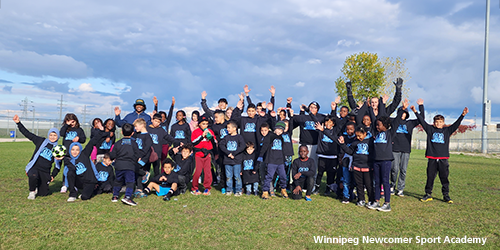
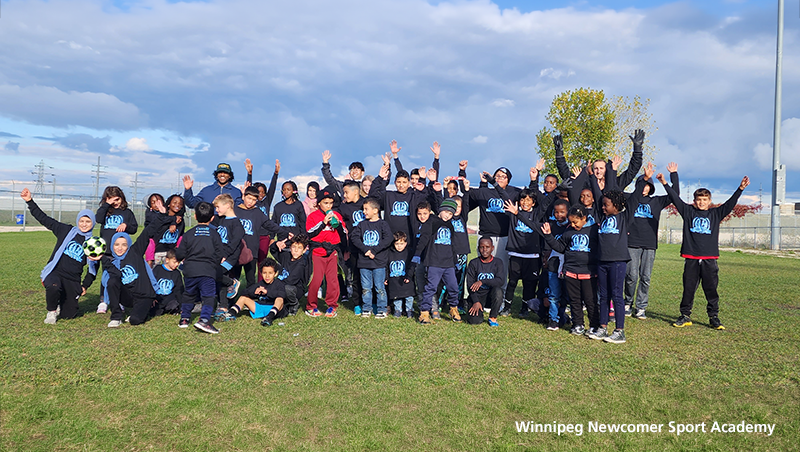
WNSA: From Outsiders to Members
The biggest shift in Winnipeg is structural. During the pilot, WNSA operated outside the provincial sport system. Manitoba Soccer‘s services, coach education, and competition structures were effectively off-limits. That’s no longer the case.
“We realized it would be to our advantage to become members of Manitoba Soccer,” said Carolyn Trono, Founder and Volunteer Executive Director of WNSA. “So we spent a few months getting the application ready, and we became members. It has opened up quite a few doors.”
Those doors include access to coach education, guidance from Manitoba Soccer’s technical and executive directors, and participation in grassroots festivals. Nine of WNSA’s female coaches are now part of the TELUS She Can Coach program. The organization has redesigned its soccer programming to be developmentally appropriate, with a structure that rewards not just goals but communication, sportsmanship, and teamwork.
Manitoba Soccer’s role has been proactive. Their technical director and executive director have helped WNSA identify barriers and navigate the system. Learning facilitators have worked directly with WNSA’s coaches. For the provincial body, the relationship is producing concrete results: a better understanding of what newcomer communities actually need from the sport system and a working model for delivering it.
“I think they learned a lot and we learned a lot,” Trono said. “Looking at ways we can collaborate instead of being adamant and hard, looking at ways we can all work together to make the sport more open.”
WNSA is also developing a three-year strategic plan for its soccer program, with accessible competition as a central goal. Standard league formats don’t fit WNSA’s reality: its participants don’t always have enough players of a single age to form full teams. So the organization is designing an adapted competition structure within its program and across inner-city organizations, so newcomer youth can experience meaningful games regardless.
The newcomer coaches are a case in point. WNSA now has a male coach from Afghanistan and a female coach from Syria leading sessions with youth. Both emerged through the community connections the pilot strengthened. “They just raise the level of enthusiasm with the kids,” Trono said.
And the youth? Some are playing on their high school teams. A few have joined local clubs. Others help referee at their schools, and some have landed jobs with the City of Winnipeg using skills built through WNSA’s youth leadership and referee training. “They’re taking the skills from their soccer training and youth leadership training and the referee training and translating those into paying jobs,” Trono said.
The motivation extends to families. WNSA took a group of 30-40 people to a Valour FC game last summer. They’ve also attended University of Manitoba soccer games. “It’s not only about the game, watching the game, but it’s part of being in the soccer community,” Trono said. “The parents enjoy being in an environment with other Canadians. It’s super special.”
None of this happens without the network WNSA has built around it: settlement agencies for referrals, school divisions for outreach, faith-based organizations like local mosques for connecting with families, the University of Winnipeg RecPlex and University of Manitoba for facility access, Jumpstart for equipment, Sport Manitoba for bilateral funding, and the City of Winnipeg for transportation. The pilot didn’t create all of those relationships, but it gave WNSA the credibility and visibility to deepen them.
IYSA: Growth, a Pivot, and Community Integration
In Burnaby, the numbers are clear. Over the three years since the pilot began (2022 to 2025), IYSA’s summer program participation has increased by 34%. Its winter indoor tournament and clinic saw a 20% jump over the same period. The West Coast Cup, held over the Christmas break, drew roughly 300 participants and spectators.
“That sparked the community and the interest because of this grant,” said Imran, an IYSA leader. “And everyone’s hyped with the World Cup coming as well.”
IYSA’s path into the provincial sport system took a different route than WNSA’s. Its application for associate membership with BC Soccer was declined due to documentation and administrative requirements. Rather than stall, IYSA pivoted to a partnership with South Burnaby Metro Club, a sanctioned multi-sport organization offering soccer, basketball, volleyball, and baseball. Through that partnership, IYSA’s community now has access to coaching courses, referee certification, field time, and subsidized participation across multiple sports. And BC Soccer is still in the picture. “They now know who we are, and we’re hoping the discussions can continue,” Imran said.
The community itself has changed in ways nobody predicted. One of the most significant shifts has been the integration of the Central Asian community within IYSA’s broader network. Afghan families who had previously stayed separate began engaging after younger players from their community got involved through the pilot’s youth camps and coaching opportunities.
IYSA’s December tournament illustrates the shift. In 2024, roughly 100 participants attended. By 2025, that number exceeded 160, with a significant portion from the Central Asian community. “Very special for me personally,” said Amyn, a senior IYSA leader.
One participant stands out. A young man with seven siblings first connected to IYSA through the fanship project, regularly requesting tickets for his entire family to attend Whitecaps games. That experience sparked his whole family’s involvement in soccer. His siblings now referee in local leagues and play for municipal clubs. He was selected to represent Canada at the Global Encounters Games in Dubai (though logistics prevented him from attending), and he volunteers as a coach and organizer at every IYSA event.
Another leader, Mustafa, rallied IYSA’s Central Asian community, started a men’s team competing in a local Burnaby league, and used grant funding to become a certified coach and technical director. He coached the women’s team at the Global Encounters tournament in Dubai. Language was part of his impact: on-field communication happens in Dari, which made Afghan families feel included in ways English-only programming could not.
IYSA has also established a women’s team competing in the local adult league, and Vancouver Rise, the city’s new NWSL club, has proactively reached out to connect with the community. “It’s been awesome just to be able to have that connection,” Imran said.
What This Means for Sport Organizations
For provincial and national sport organizations, the takeaway from this pilot is practical: when newcomer-serving organizations get connected to the sport system, the result is stronger communities, more participation, and more people active for life.
Canada Soccer has taken steps in this direction. Its Club+ initiative now includes a “New to Canada” section providing clubs with tools and resources for designing programs that welcome newcomers, informed by current research and the experiences of projects like this one. Canada Soccer also introduced an EDI policy and finalized an IDEA Action Plan, both of which are available on its website.
WNSA and IYSA’s participants were already motivated. They already loved soccer. What they lacked were clear pathways into the organized sport system and relationships with people who could open them. When those connections were made, participation grew, coaching capacity expanded from within the community, and the organizations became more integrated with mainstream sport, not less.
The barriers these organizations still face are real: competition structures that assume standard team sizes, membership processes designed for established clubs, language gaps in coaching materials, and the persistent challenge of transportation and funding. But the progress over 18 months shows that when sport systems make room for newcomer-serving organizations, both sides benefit.
Sport for Life is building on this work through the New-to-Canada Long-Term Development Pathway, community resources for newcomer-serving organizations, and a project supporting 30 equity-deserving organizations in sport. The Wellness through Community Connections project in Greater Victoria, a partnership with the Intercultural Association of Victoria and the University of Victoria, is applying similar principles to improve social connections for newcomers through sport and physical activity.
For organizations looking to start, the entry points aren’t complicated: connect with your local settlement agencies and immigrant partnerships, understand who in your community is new and what sports they already care about, and design your first invitation with their reality in mind. Sport for Life can help. Reach out to us to discuss how to apply these approaches in your community.
Resources
For coaches, leaders, and organizations working with newcomer communities, Sport for Life offers:
- Welcome to Canada: Engaging New to Canada Participants in Sport and Physical Activity, an on-demand eLearning course available on Sport for Life Campus.
- Engaging Those Who Are New to Canada Via Physical Literacy and Quality Sport, a bookable workshop for organizations and communities.
- Overcoming vs. Dismantling Barriers to Sport and Physical Activity for New to Canada Participants, a recorded webinar.
- Sport for Life for Every New-to-Canada Participant 2.2, a practical resource for program leaders.
- New-to-Canada Participants Long-Term Development in Sport and Physical Activity Pathway, the full NLTD document.
The Newcomer Fanship Project was funded by the Government of Canada. Sport for Life partnered with the Winnipeg Newcomer Sport Academy, the Ismaili Youth Soccer Academy, Canada Soccer, and the University of Western Ontario’s Centre for Studies in Family Medicine.
Watch the Newcomer Fanship Project Impact videos to hear directly from participants and community leaders.