
What Circus Arts Taught Researchers About Physical Literacy
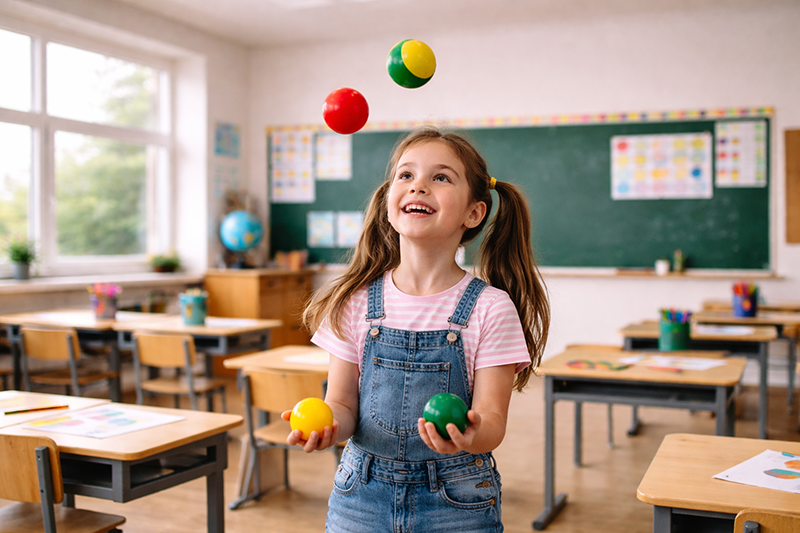
A group of kids in Montreal spent their physical education classes learning to juggle, swing on a trapeze, and balance on a rola bola, rather than the usual gym activities. The program was run in partnership with the National Circus School in Montreal. At the end of one semester, researchers assessed their skills, not their circus skills, but the fundamental movement skills you’d expect any physical education class to develop: running, throwing, balancing, and coordination.
The circus kids outperformed the standard physical education group. Grade 5 students in the circus program scored higher on 15 of 18 movement skills. Grade 4 students scored higher on 7 of 18. And it went beyond physical competence. Circus students also showed greater confidence, better comprehension of movement terminology, and increased participation in physical activities outside of circus.
That’s the transfer effect, and it matters for everyone working in physical literacy.
What Happened in the Study
To measure outcomes, the research team used three of Sport for Life’s Physical Literacy Assessment for Youth (PLAY) Tools: PLAYfun, PLAYself, and PLAYinventory, capturing data from trained assessors and the children themselves.
Both groups improved their motor competence over the semester, but the circus group improved significantly more. The gender gap in motor competence was also smaller in the circus schools, with particular benefits for girls, likely due to the inclusive and participatory nature of circus, where activities and the learning environment differ from those in traditional sport.
Why This Matters for Physical Literacy
Physical literacy is the motivation, confidence, physical competence, knowledge and understanding to value and take responsibility for engagement in physical activities for life. This research shows that the type of movement experience matters as much as the amount.
Most physical literacy programs still focus on sport-based delivery. That’s an important foundation, but it’s not the only path, and it may not be enough on its own. Circus arts hit elements that traditional sport often misses. Participants learn to perform for an audience, not just in front of one. They develop creativity, expression, risk-taking, trust, and perseverance alongside physical skills. The activities are novel enough that nearly all children start on equal footing, with no advantage from years of hockey or soccer, which means confidence builds differently.
This aligns directly with what Long-Term Development in Sport and Physical Activity tells us: diverse movement experiences build a stronger foundation of physical literacy. Early specialization narrows the range. Broad, rich, varied movement expands it.
What This Means for Your Programming
If you’re a recreation director, a school administrator, a community sport leader, or a coach, this research raises a practical question: Are the movement experiences in your programs diverse enough to develop the full range of physical literacy?
That doesn’t mean every program needs a trapeze. It means thinking about whether your participants are getting enough variety in the movements they perform, the environments they move through, and the ways they’re asked to use their bodies. A community recreation program that rotates through basketball, dance, and martial arts across a season is building a broader movement vocabulary than one that runs basketball year-round. Dance, theatre, circus, martial arts, outdoor adventure: these aren’t alternatives to physical literacy development. They are for physical literacy development.
The PLAY Tools Connection
It’s no coincidence that the PLAY Tools were at the centre of this research. Dr. Dean Kriellaars, who led the circus study, is the same researcher who developed the PLAY Tools in collaboration with Sport for Life. It’s no surprise, then, that these tools were at the centre of the research. When he needed to measure whether an arts-based approach actually develops physical literacy, he used the tools he built for exactly that purpose.
PLAYfun measured movement competence across 18 fundamental skills. PLAYself captured how the children perceived their own physical literacy. PLAYinventory tracked their participation in activities beyond the program. Together, these tools showed not just that the circus kids moved better, but that they felt better about moving and were choosing to move more.
That’s what physical literacy observation should do: see the whole child, not just the physical output.
Explore the PLAY Tools at play.physicalliteracy.ca.
Notes
Dean J. Kriellaars, John Cairney, Marco A.C. Bortoleto, Tia K.M. Kiez, Dean A. Dudley, and Patrice Aubertin, “The Impact of Circus Arts Instruction in Physical Education on the Physical Literacy of Children in Grades 4 and 5,” Journal of Teaching in Physical Education 38, no. 2 (2019): 162–70. https://doi.org/10.1123/jtpe.2018-0269
Lisa M. Barnett, Rea Dennis, Kate Hunter, John Cairney, Richard J. Keegan, Inimfon A. Essiet, and Dean A. Dudley, “Art Meets Sport: What Can Actor Training Bring to Physical Literacy Programs?” International Journal of Environmental Research and Public Health 17, no. 12 (2020): 4497. https://doi.org/10.3390/ijerph17124497
