
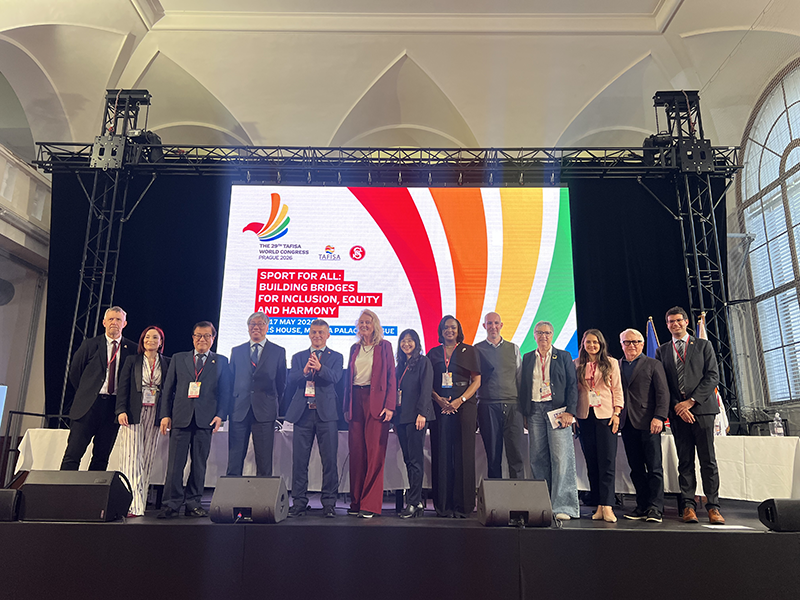
Sport for Life founder Richard Way has been elected Vice-President – Americas on the Board of Directors of The Association For International Sport for All (TAFISA). The election took place at the TAFISA General Assembly on May 15, 2026, during the 29th TAFISA World Congress in Prague, Czech Republic. Way will serve a four-year term (2026–2029) on the newly elected Board of Directors, led by incoming TAFISA President Janez Sodržnik of Slovenia.
For Way, the appointment is both deeply personal and strategically significant. His career has been built on Sport for Life and quality Sport for All, and this is the first time that work has translated into a formal governance role on the global stage.
“My career has been all about Sport for Life and quality Sport for All. Personally, it’s a tremendous honour and a great opportunity to share knowledge. Professionally, it’s a chance to bring the perspectives of physical literacy and Long-Term Development to a global association,” said Way.
The role creates a direct channel between Sport for Life’s evidence-informed approach and TAFISA’s global network, giving Canadian expertise a stronger, more formal voice in shaping international Sport for All strategy and policy. Way sees the connection flowing both directions: the position also opens the door for Canada to learn from other nations’ approaches to inclusion and participation, strengthening the work at home.
Among his priorities for the 2026–2029 term, Way plans to champion greater collaboration across the Americas, including the sharing of knowledge, resources, education and training among countries with very different levels of infrastructure and investment. He is also committed to keeping physical literacy and inclusion for underrepresented groups — including Indigenous communities, people with disabilities, and older adults — central to the Board’s agenda.
Way sees a natural alignment between Sport for Life’s core work and TAFISA’s broader mission.
“Developing physical literacy gives people the competence and confidence to stay active for life. Paired with Long-Term Development thinking, it shifts the focus from short-term participation in sport to sustainable, inclusive, lifelong Sport for All pathways — which is exactly the foundation of TAFISA,” explained Way.
Looking ahead, Way points to real potential in joint knowledge-exchange platforms, shared training resources, and coordinated advocacy around physical literacy and sport frameworks that can be adapted across cultures and contexts. TAFISA’s global reach, paired with Sport for Life’s implementation expertise, could accelerate progress in regions that are still building their Sport for All ecosystems.
The election is the latest in a series of milestones deepening Sport for Life’s relationship with TAFISA. At the same Prague Congress, Sport for Life received the TAFISA Mission 2030 Award for its New-to-Canada Long-Term Development in Sport and Physical Activity Pathway (NLTD), a framework that builds new-to-Canada participant inclusion into the design of sport and physical activity systems from the start. And this October, Sport for Life will co-host the 2026 International Physical Literacy Conference (IPLC) with Toulouse Université Club in Toulouse, France — an event prominently featured on TAFISA’s own homepage.
“It recognizes Sport for Life’s positive influence on international thinking and marks a shift to Sport for Life having a formal seat at the global governance table. It’s the culmination of a long-term journey that now positions Canadian expertise as a genuine contributor to the worldwide movement — and signals that this work is increasingly relevant,” reflected Way.